Skip to content
IMH

Best Picks

The Best Bathroom Faucets - and the One Measurement That Decides What Fits

A new faucet is the fastest way to make a tired vanity look renovated. It only works if you buy for the holes you already have.

By Catherine Vizcaino · Home-renovation pro & founder

Updated September 2026

A warm bathroom styled with towels and plants

As an Amazon Associate, I Heart My Home earns from qualifying purchases. It never changes your price or our picks. Learn more.

When a client wants a bathroom to feel new and the budget will not stretch to a new vanity, the faucet is where I start. It is a small object that sits dead center in the room, at eye level when you lean in, lit by the brightest light in the house - and a dated, pitted faucet makes an otherwise decent vanity look twenty years older than it is. Swap it, and the same vanity suddenly reads as a choice.

It is also the fixture most likely to arrive and not fit. Bathroom faucets are sold by the picture and installed against a set of holes that were drilled into your vanity top years ago, and those holes do not move. A beautiful widespread faucet is useless on a four-inch top, a standard faucet is too short for a vessel bowl, and a faucet that does not include a drain leaves you pairing it with the tired old one. Every one of those problems is a five-minute check before you order and a return afterward.

So here are the five things that decide this purchase, in the order they matter. One, the spread: count the holes in your vanity top and measure center to center between the outer two - that number tells you whether you need a single-hole, a 4-inch centerset, or an 8-inch widespread faucet. Two, the sink type: a vessel bowl that sits on the counter needs a tall faucet built for it. Three, height and reach: the stream should land near the drain, not on the back of the basin. Four, the drain: whether one is included, and whether your sink needs an overflow or no-overflow type. Five, serviceability and finish: a brand whose parts you can still buy in ten years, in a finish that suits your water. Then eight picks, one for each common bathroom: the standard centerset, the cheapest honest option, matte black for a one- or three-hole top, an 8-inch widespread, warm brushed gold, a vessel faucet, vintage cross handles, and the drain. If the kitchen is next on the list, the kitchen faucet guide runs on the same logic, and the wider bathroom decor plan covers the mirror, storage and soft layers around it.

One honesty note before you shop. I have replaced a lot of bathroom faucets, but I have not bench-tested these specific models against each other and I will not pretend otherwise - every specification below comes from the manufacturer’s own listing, every buying rule comes from a source I have linked, and where a listing does not state something, this page tells you to check rather than guessing on your behalf. Amazon pricing also moves all day, so where a live price is not available you will see a Check price on Amazon button rather than a number I cannot stand behind. As an Amazon Associate we earn from qualifying purchases at no cost to you - our editorial policy and affiliate disclosure spell out exactly how that works.

Quick picks at a glance

#ProductBest forPrice
1
A warm bathroom styled with towels and plants
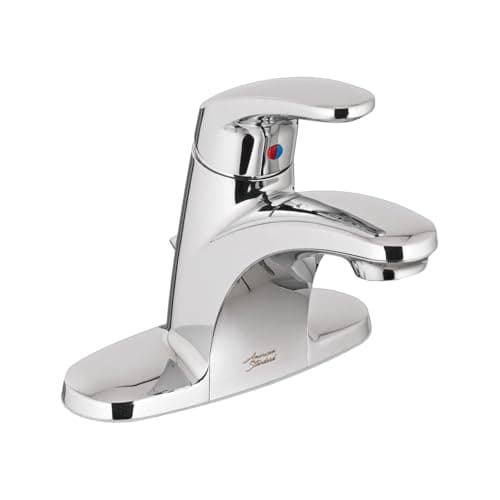
American Standard Colony Pro Single-Handle Bathroom Sink Faucet with Metal Drain, 1.2 GPM, Polished Chrome 7075000.002

A single-lever 4-inch centerset from a mainstream plumbing brand, with a metal drain in the box - the straight swap for the three-hole vanity top so many bathrooms already have.

the standard three-hole vanity top
2
An affordable, cozy living room styled on a budget
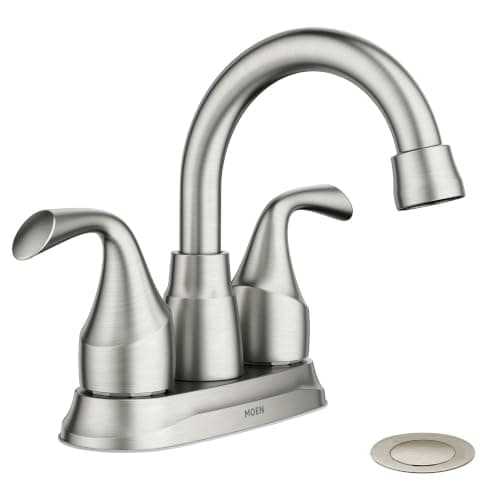
Moen Idora Spot Resist Brushed Nickel Two-Handle Centerset Bathroom Sink Faucet with Drain Assembly, 84115SRN

The least expensive faucet on this page, and still a Moen with a drain assembly in the box - the budget pick that does not trade away repairability.

kids' baths, rentals, and the lowest honest cost
3
A round wall mirror in a styled entryway
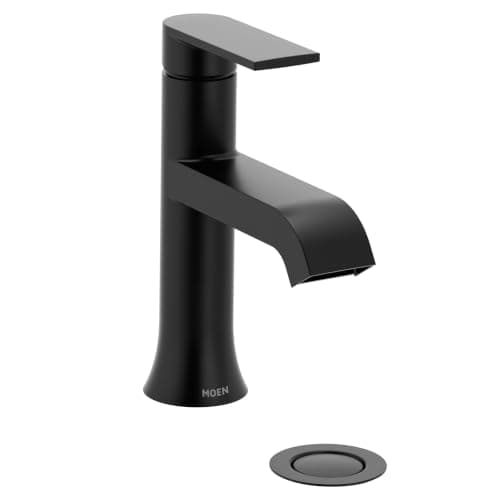
Moen Genta LX Matte Black One-Handle Modern Bathroom Sink Faucet with Optional Deckplate for Three-Hole or One-Hole Sinks, 6706BL

A modern one-handle faucet in matte black whose optional deckplate lets it sit on a one-hole top or cover a three-hole one - the flexible pick for the single-hole look.

matte black on a one-hole or three-hole top
4
An assortment of home goods and kitchenware
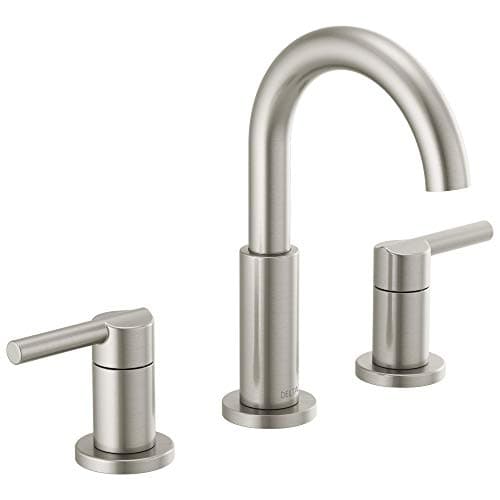
Delta Nicoli Brushed Nickel 8 Inch Widespread Bathroom Sink Faucet, 3 Hole, Push-Pop Drain Assembly, Stainless 35749LF-SS

An 8-inch widespread with a push-pop drain - the layout that makes a larger vanity look properly fitted rather than under-dressed.

an 8-inch widespread vanity or a double sink
5
An interior in earthy terracotta and sage tones
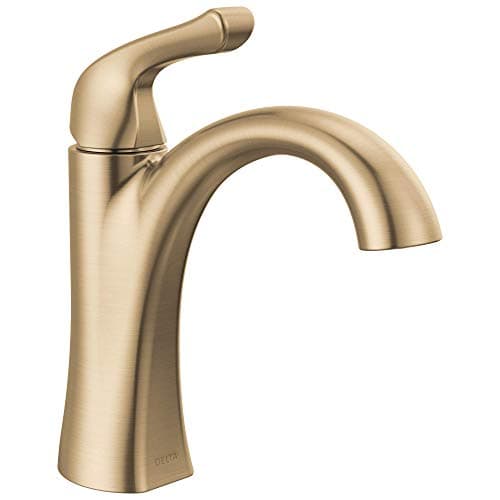
Delta Arvo Brushed Gold Single Hole Bathroom Sink Faucet, Push-Pop Drain Assembly, Champagne Bronze 15840LF-CZ

Delta's Champagne Bronze finish on a single-hole faucet with the drain included - the warm-metal pick, priced in the middle of this page rather than at the top.

a warm-metal bathroom without a designer price
6
Ceramic vases styled on a shelf
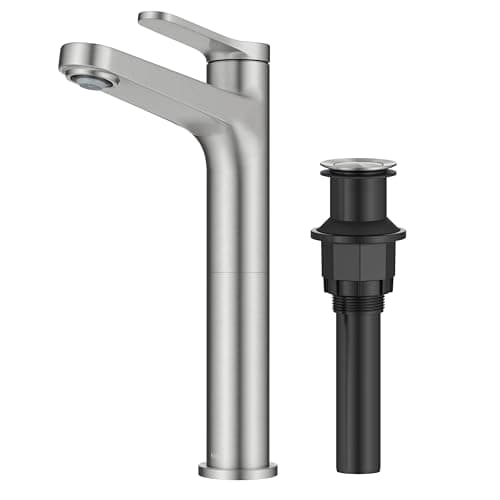
KRAUS Indy Bathroom Faucet for Vessel Sink, Spot-Free Brushed Nickel, Single Handle, Pop Up Drain and Supply Lines, KVF-1410SFBN

A single-handle faucet made for vessel sinks, with the pop-up drain and the supply lines in the box - so the parts people forget arrive together.

a vessel bowl that sits on top of the counter
7
A vintage-styled room with antique furniture and warm accents
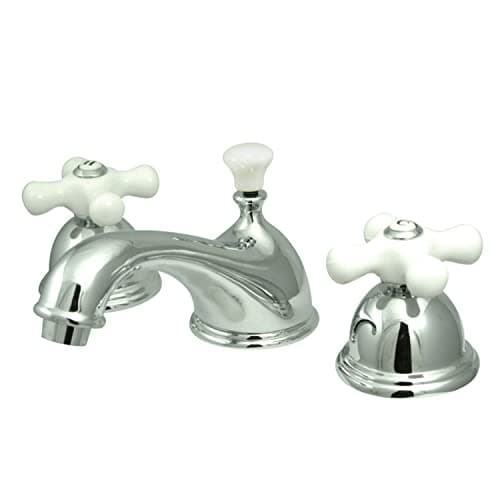
Kingston Brass KS3961PX Restoration Widespread Lavatory Faucet with Porcelain Cross Handle, Polished Chrome, 8-Inch Adjustable Center

Porcelain cross handles on an 8-inch widespread in polished chrome - the traditional shape that suits an older house or a subway-tile bathroom.

vintage, farmhouse and period bathrooms
8
An organized closet with storage bins and baskets
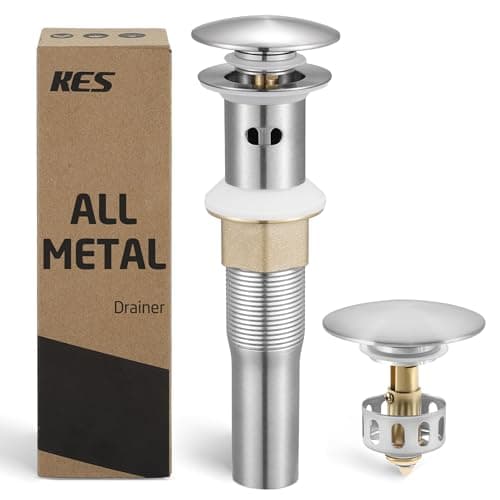
KES All Metal Bathroom Sink Drain with Strainer Basket, Pop Up Drain Stopper for Sinks with Overflow, 18/8 Stainless Steel, Brushed Nickel, S2013A-BN

An all-metal pop-up drain with a hair-catching strainer basket - the inexpensive part that decides whether a new faucet looks finished or looks like it is sitting on an old sink.

a faucet with no drain, or an old drain that lets the swap down

Tap any row to jump to the full write-up. Prices open on Amazon in a new tab.

How we chose these picks

Every pick here is chosen the way I’d choose it for a client’s home: real-world durability first, build quality and materials second, and value for the money third. Where I’ve installed or lived with a product on a job, I say so and tell you what I saw. Where a pick is based on research and verified buyer feedback rather than hands-on use, I say that too — I never claim to have tested something I haven’t.

Read our full editorial policy for how we evaluate and update these guides.

A warm bathroom styled with towels and plants

A single-lever 4-inch centerset from a mainstream plumbing brand, with a metal drain in the box - the straight swap for the three-hole vanity top so many bathrooms already have.

If you asked me to replace the faucet in a typical bathroom without seeing it, I would bet on three holes, four inches apart - it is one of the most common vanity layouts, and it is why the centerset is the default swap. This American Standard is the pick because it covers the things that make that swap go smoothly: the manufacturer builds it for exactly that spacing, it uses one lever instead of two handles, it ships with a metal drain so you are not pairing a new faucet with a pitted old one, and American Standard lists a memory-position valve, so it turns back on at the temperature you last used. The brand matters for the same reason it matters in a kitchen: a faucet that starts dripping in eight years is a cartridge job on a mainstream platform and a whole new faucet on an anonymous one.

$90.98 · View on Amazon

#ad · disclosure · Price as of September 19, 2026

Pros

  • American Standard specifies it as a 4-inch centerset for a three-hole top - one of the most common vanity layouts
  • Single lever handle, so temperature and flow are one motion rather than two
  • Metal drain included, per the listing, and a ceramic disc valve cartridge, per the manufacturer
  • 1.2 gpm and WaterSense certified, per American Standard - comfortably under the 1.5 gpm WaterSense ceiling

Cons

  • Only fits a 4-inch spread - an 8-inch widespread top or a single-hole top needs a different faucet
  • Polished chrome shows water spots and fingerprints far more than a brushed finish
  • A 1.2 gpm faucet fills a basin more slowly than an older, higher-flow faucet, which some people notice
  • Neither the listing title nor the manufacturer's page states spout height or reach, so check both against your basin
An affordable, cozy living room styled on a budget

The least expensive faucet on this page, and still a Moen with a drain assembly in the box - the budget pick that does not trade away repairability.

Every house has a bathroom that does not deserve an expensive faucet: the kids' bath that gets toothpaste on everything, the basement half bath, the rental you are turning over between tenants. The mistake is solving that with a no-name faucet, because the cheapest faucets tend to be the ones nobody sells parts for. This Moen sits at the bottom of the price range on this page and still comes from a brand whose parts are sold almost everywhere, with a drain assembly included and a brushed nickel finish that forgives hard water. That is what a budget pick should be - cheap to buy and cheap to keep.

$50.99 · View on Amazon

#ad · disclosure · Price as of September 19, 2026

Pros

  • Lowest cost of any faucet on this page
  • Drain assembly included, per the listing, so the whole swap is one order
  • Spot Resist brushed nickel is designed by Moen to play down water spots and fingerprints
  • Mainstream brand, so a drip later means a replacement part rather than a replacement faucet

Cons

  • Two handles mean mixing hot and cold by hand every time, which children and guests find fussy
  • A centerset only - confirm your outer holes are 4 in apart before ordering
  • A plain, builder-grade shape that will not be the design moment in the room
  • The listing title states no spout height or reach, so check it against a small or shallow basin
A round wall mirror in a styled entryway

A modern one-handle faucet in matte black whose optional deckplate lets it sit on a one-hole top or cover a three-hole one - the flexible pick for the single-hole look.

Matte black has settled in as a standard bathroom neutral rather than a passing trend, which makes it worth buying from a brand with a parts channel instead of buying cheaply. This Genta LX earns its place for one specific reason, though: the optional deckplate. A lot of people replacing a bathroom faucet want the clean one-handle look but are standing over a vanity top that already has three holes, and a faucet designed to go either way removes that problem. It is the pick for anyone who wants black and a single handle without replacing the top to get them.

$158.98 · View on Amazon

#ad · disclosure · Price as of September 19, 2026

Pros

  • Optional deckplate means it suits one-hole and three-hole tops, per the listing
  • Matte black works with white, wood-toned and dark-painted vanities alike
  • A one-handle, one-body faucet keeps a small vanity deck visually clear and easy to wipe
  • Major-brand platform, so replacement cartridges stay available

Cons

  • Matte black shows dried limescale more than any other finish - hard-water homes will be wiping it
  • This listing does not say a drain is included, so budget for one if yours is tired
  • A deckplate covering three holes never looks quite as clean as a true single-hole top
  • Black tones vary between brands, so it may not match black hardware or a black light fixture exactly
An assortment of home goods and kitchenware

An 8-inch widespread with a push-pop drain - the layout that makes a larger vanity look properly fitted rather than under-dressed.

A widespread faucet is what a larger vanity is waiting for. The spout and the handles are separate pieces spaced out along the counter and joined underneath, and that spread is what makes a wide single vanity or a double vanity look properly fitted instead of like it borrowed a faucet from a powder room. This Delta Nicoli is the pick because it is a mainstream platform in the most forgiving finish, with the drain included, built for the 8-inch spacing that widespread tops are commonly drilled at. On a double vanity, buy both faucets in one order - it is the only reliable way to be sure the two finishes match.

$184.90 · View on Amazon

#ad · disclosure · Price as of September 19, 2026

Pros

  • Built for the 8-inch widespread layout, which a centerset simply cannot fill
  • Separate spout and handles give a wide vanity a more substantial look
  • Push-pop drain included, per the listing
  • Brushed-nickel-look Stainless finish is forgiving of water spots

Cons

  • Separate pieces connected under the deck make installation fiddlier than a centerset
  • Two handles to set the temperature, every time
  • Needs a three-hole widespread top - on a single-hole or 4-inch top it will not fit at all
  • Costs more than the centerset picks, and a double vanity means buying two
An interior in earthy terracotta and sage tones

Delta's Champagne Bronze finish on a single-hole faucet with the drain included - the warm-metal pick, priced in the middle of this page rather than at the top.

Warm metal does more in a bathroom than almost anywhere else, because bathrooms are the coldest rooms in the house to look at: white tile, white porcelain, glass, and often a cool light overhead. One brushed gold faucet stops the whole room reading clinical. This Delta Arvo is the pick because it pairs that finish with the practical details - a single hole for a clean deck, a drain included, and a mainstream brand behind it. Brushed rather than polished is the version I would put over a sink that gets used every morning and every night, because polished gold becomes a fingerprint record and brushed simply does not.

$125.68 · View on Amazon

#ad · disclosure · Price as of September 19, 2026

Pros

  • Brushed gold warms up white tile, pale counters and wood vanities
  • A brushed texture hides marks far better than polished metal does
  • Push-pop drain included, per the listing
  • Single-hole footprint keeps a small vanity looking clean

Cons

  • The listing title does not mention a deckplate, so on a three-hole top confirm one is available first
  • Champagne Bronze is Delta's own tone and will not necessarily match another brand's brass or gold
  • Warm metals date faster than nickel or chrome if you follow trends closely
  • A faucet is a bigger commitment to a metal than a towel bar you can swap in ten minutes
Ceramic vases styled on a shelf

A single-handle faucet made for vessel sinks, with the pop-up drain and the supply lines in the box - so the parts people forget arrive together.

Vessel sinks are the one bathroom setup where the faucet decision is really a geometry problem. The bowl sits on top of the counter, so the faucet has to be tall enough to clear the rim and reach far enough that the water lands inside the bowl near the drain rather than on the edge. An ordinary bathroom faucet fails both tests. This KRAUS Indy is the pick because it is built for that job and bundles the pop-up drain and the supply lines - exactly the parts people forget to order with a vessel faucet and then wait another week for.

$144.9515% off

$122.93 · View on Amazon

#ad · disclosure · Price as of September 19, 2026

Pros

  • Made for vessel sinks, where a standard-height faucet cannot clear the rim
  • Pop-up drain and supply lines included, per the listing
  • Spot-Free brushed nickel is designed by KRAUS to resist water spots and fingerprints
  • A single handle is easy to reach beside a raised bowl

Cons

  • The listing title does not state spout height or reach - check both against your bowl before ordering
  • The title does not say whether the included drain is an overflow or no-overflow type, so confirm it matches your bowl
  • Only for vessel sinks - over a standard undermount or drop-in sink it stands far too tall
  • Vessel setups splash more than recessed sinks when the stream lands off-center
A vintage-styled room with antique furniture and warm accents

Porcelain cross handles on an 8-inch widespread in polished chrome - the traditional shape that suits an older house or a subway-tile bathroom.

A traditional bathroom falls apart on its details, and the faucet is the biggest one. A sleek modern lever under a run of subway tile and a beadboard wall reads as a mistake, while porcelain cross handles read as a house that was looked after. Kingston Brass is the maker I would turn to for that shape without going to the specialist restoration end of the market, and the widespread format gives the handles room to be seen. Choose it with clear eyes: cross handles are less convenient than a single lever, and the look is the whole reason to buy it.

$270.67 · View on Amazon

#ad · disclosure · Price as of September 19, 2026

Pros

  • Porcelain cross handles are the classic detail for a vintage or period bathroom
  • Listed with an 8-inch adjustable center, so it is made for a widespread three-hole top
  • From a brand whose range leans heavily on traditional faucet shapes
  • Polished chrome suits the vintage look this faucet is designed for

Cons

  • Comfortably the most expensive faucet on this page
  • Polished chrome shows every water spot and fingerprint
  • Cross handles need a grip-and-twist, which is harder for small or arthritic hands than a lever
  • The listing title does not mention a drain, so check before assuming one is included
An organized closet with storage bins and baskets

An all-metal pop-up drain with a hair-catching strainer basket - the inexpensive part that decides whether a new faucet looks finished or looks like it is sitting on an old sink.

The drain is the part of a faucet swap nobody budgets for and everybody notices. A new faucet above a pitted, discolored old drain looks like half a job, and two of the faucets on this page do not say in their listing titles that a drain is included. This KES is the pick because it solves that for very little money, in all metal rather than plastic, and its strainer basket deals with the hair that turns a bathroom sink into a slow drain. It is the item on this page I would add to the cart for almost any faucet swap where the old drain has seen better days.

$19.99 · View on Amazon

#ad · disclosure · Price as of September 19, 2026

Pros

  • By far the least expensive item on this page
  • All-metal build in 18/8 stainless steel, per the listing
  • A strainer basket catches hair before it becomes a slow drain
  • Brushed nickel suits the most common bathroom faucet finish

Cons

  • Only for sinks that have an overflow hole - a bowl without one needs a no-overflow drain instead
  • The listing title does not state the drain hole size it fits, so check before ordering
  • A strainer basket needs emptying, or it becomes the clog it was meant to prevent
  • Its brushed nickel will not necessarily match another brand's brushed nickel exactly

How to buy a bathroom faucet that actually fits

Work through these before you get attached to a finish. Each one is a quick check that prevents a return, and it is the same list I run before ordering for a client:

  • Count the holes, then measure the spread. The key measurement is the distance from the center of the left hole to the center of the right hole. A 4-inch centerset faucet is designed for a three-hole top whose outside holes are 4 inches apart; widespread faucets start at 8 inches, and many fit wider spreads up to 16 inches depending on the model; and many single-hole faucets can go on a three-hole top if they include a deck plate that covers the unused holes (bathroom faucet fit guide).
  • Know what kind of sink you have. An undermount or drop-in sink takes a deck-mounted faucet of normal height. A vessel bowl sitting on the counter needs a taller faucet that clears the rim and reaches far enough for the water to land inside the bowl, ideally near the drain. A wall-mounted faucet comes out of the wall rather than the counter, which is a different job altogether.
  • Check height and reach against the basin. Too short a reach and you wash your hands against the back of the sink; too long and the stream hits the far edge and splashes. Small, shallow basins are the least forgiving of a tall spout.
  • Settle the drain question. Some faucets include a drain and some do not. And the drain has to suit the sink: if your sink has an overflow, you need a drain with an overflow opening; if it has no overflow hole, it needs a drain without one (overflow vs no-overflow drains).
  • Read the flow rate. The maximum flow rate for bathroom faucets has been 2.2 gallons per minute at 60 psi since 1994, and a WaterSense-labeled faucet must flow no more than 1.5 gpm at 60 psi and no less than 0.8 gpm at 20 psi (Building America Solution Center). Unlike kitchen faucets, bathroom faucets are covered by WaterSense, so the label is worth looking for.
  • Confirm it is certified lead free. Under the Safe Drinking Water Act, “lead free” means a weighted average of no more than 0.25% lead across the wetted surfaces of a plumbing fitting or fixture (EPA lead free requirements). Mainstream faucets sold for drinking water in the US are certified to it; verify on any listing that does not say so.

Do those six and the shopping gets easy, because you are choosing between faucets that all physically fit. The faucet you end up with should also be planned alongside the mirror and light above it - the bathroom decor guide covers how those pieces work together.

Single-hole, centerset, widespread, vessel or wall-mount

These are not better and worse versions of the same thing. They fit different vanity tops, and the one you need is mostly decided by the holes you already have:

  • Single-hole. One opening, one lever, one body. The cleanest look and the easiest to wipe around, which makes it a favorite for small vanities and modern bathrooms. On a three-hole top it needs a deckplate, like the Moen Genta LX above.
  • 4-inch centerset. Spout and handle or handles on one base spanning three holes 4 inches apart. The everyday builder layout and the easiest like-for-like swap - see the American Standard Colony PRO and the budget Moen Idora.
  • 8-inch widespread. A separate spout and two separate handles, joined under the deck. It needs a wider vanity to look right, rewards it when it has one, and takes longer to install - the Delta Nicoli and the Kingston Brass are both this layout.
  • Vessel. A tall faucet for a bowl that sits on top of the counter, usually single-hole. Height and reach are everything, which is why the KRAUS Indy is sold for this job specifically.
  • Wall-mount. Installed into the wall above the sink instead of the counter. It looks wonderful with a vessel bowl or a slab counter, but the valve lives inside the wall, so it belongs in a renovation that is opening walls anyway - not in a weekend faucet swap.

Changing layout is where a faucet project quietly becomes a vanity project. Going from a 4-inch centerset to an 8-inch widespread means new holes, and in a stone or cultured-marble top that usually means a new top. If you want a different layout, price the top first; if you do not, buy the faucet that fits the holes you have and put the savings into the rest of the room.

Choosing a finish you can live with - and match

Finish is the fun part, and it is also the part that decides how much cleaning you signed up for. Here is how the common options behave in a real bathroom:

  • Polished chrome. Bright, traditional, and the easiest to match across towel bars and accessories - but it shows every water spot and fingerprint.
  • Brushed nickel and brushed stainless looks. The most forgiving day to day. The brushed texture scatters light, so spots and smudges are far less visible, which is why half the picks here use it.
  • Matte black. The most versatile against vanity colors and the least forgiving with hard water, because dried mineral deposits are white and sit on a dark surface in plain view.
  • Brushed gold, champagne bronze and brass. Warm, and far easier to live with brushed than polished - but tones differ between manufacturers, so a gold faucet and a gold towel bar from two brands rarely match exactly.

The rule that saves the most grief: choose the faucet finish first, then match everything else to it. The faucet is the hardest metal to change later, and the towel bars, cabinet pulls and light fixture are easy to buy afterward and hold against it in your own light. The same logic appears in my cabinet hardware guide, and if the vanity light is being replaced too, the light fixtures roundup includes a vanity light in brushed nickel.

The drain, the supply lines and the other parts people forget

A bathroom faucet swap stalls on small parts far more often than on the faucet itself. Check each of these before faucet day, so the job does not stop halfway with the water off:

  • The drain. If your faucet listing does not say a drain is included, assume it is not. Decide whether you need an overflow or no-overflow type by looking for the overflow opening near the top of the basin, as covered above.
  • Supply lines. Measure from the shutoff valves to the faucet connections and buy new braided lines of the right length, unless the faucet includes them. Old supply lines are the wettest failure under any sink.
  • The deckplate. Putting a single-hole faucet on a three-hole top needs one. Some faucets include it, some offer it as an option, and some do not make one at all.
  • The aerator. The small screen at the tip of the spout. EPA notes that water-saving aerators can cost as little as a few dollars (EPA WaterSense), and a clogged one is the usual cause of weak flow on a faucet that is otherwise fine.
  • Sealant for the drain flange. Some drains seal with a gasket and some call for plumber’s putty or silicone. Follow the drain’s instructions rather than habit, and have the right one on hand before you start.

None of these are expensive, and together they are the difference between a two-hour job and a two-trip job. It is the same order-everything-first approach behind the DIY home decor guide.

One handle or two?

This looks like a style question and it is really a question about who uses the sink:

  • One handle sets temperature and flow in a single motion. It is the easier choice for children, older relatives and anyone with limited grip, and the one I default to for a family bathroom.
  • Two handles let you set hot and cold separately, which some people genuinely prefer, and they are the correct shape for traditional and vintage bathrooms. The trade-off is mixing the temperature by hand every time you wash.
  • Lever versus cross or knob handles matters for grip. A lever can be nudged with a wrist; a cross handle or knob needs a grip and a twist.
  • Two handles mean two valves to service instead of one. On a mainstream brand that is a minor point, but it is a point.

If the bathroom belongs mostly to children or guests, a single lever wins. If it is a period bathroom you are restoring, two handles are part of the look and worth the small inconvenience.

Where the money matters, and where it does not

Bathroom faucets span a wide price range, and most of the difference is finish and design rather than how well water comes out. Buyer-first, this is where I would and would not spend:

  • Spend on the brand, not the features. A faucet from a maker whose cartridges are sold everywhere is the real long-term saving. The cheapest faucet on this page is still a mainstream brand for exactly that reason.
  • Spend on the primary bathroom you see every day. Finish and feel matter most where you use the sink twice a day.
  • Do not overspend on a rental, a basement bath or a kids’ bath. A clean, working faucet from a real brand is the whole job.
  • Do not buy a layout change you did not budget for. A widespread faucet on a centerset top is not an upgrade - it is a new vanity top.
  • Do not skip the drain to save money. It is the cheapest part of the job and the one that decides whether the swap looks finished.

Put that way, a bathroom refresh can be surprisingly cheap: a new faucet and drain, a better mirror, and fresh towels do most of what a full remodel does to how the room feels. The budget decorating guide covers the same thinking across the rest of the house.

Replacing a bathroom faucet yourself, and when to call a plumber

A like-for-like bathroom faucet swap is a reasonable DIY job for most people - awkward rather than difficult, because the work happens inside a vanity cabinet. This order keeps it to an afternoon:

  • Clear the cabinet and photograph everything. Shutoff valves, supply lines, the drain linkage and the mounting hardware. You will want that picture, and you cannot take it once the old faucet is out.
  • Test the shutoff valves first. Turn them off and open the faucet. If a valve will not close, weeps, or spins freely, stop and deal with that before anything else.
  • Fit what you can from above. Attach supply lines to the new faucet before it goes through the deck, where you have light and room to work.
  • Install the drain carefully. Match the drain type to the sink, clean the old sealant off the drain hole, and follow the drain’s instructions for gasket or putty.
  • Flush before the aerator goes on. Run hot and cold with the aerator off for a short while, then thread it on. Debris knocked loose during the swap clogs a new aerator immediately.
  • Check for leaks twice. Once with the water on, and again the next morning with a dry paper towel under every connection.

Call a plumber when the shutoff valves are seized or leaking, when the supply pipes are corroded, when you are converting to a wall-mount faucet, or when new holes need drilling in a stone top - that last one is a fabricator’s job. Everything short of that is within reach of a basin wrench, a flashlight and some patience.

Frequently asked questions

How do I know what size faucet my bathroom sink needs?

Count the holes in your sink or vanity top and measure center to center between the two outer holes. One hole means a single-hole faucet. Three holes 4 inches apart means a 4-inch centerset faucet. Three holes 8 inches or more apart means a widespread faucet, and many widespread faucets fit spreads up to 16 inches depending on the model. If your bowl sits on top of the counter, you need a taller vessel faucet.

Can I put a single-hole faucet on a three-hole sink?

Often, yes. Many single-hole faucets can be installed on a three-hole vanity top if they include or offer a deck plate, also called an escutcheon, that covers the unused holes. Check that the faucet lists a deck plate and that the plate is wide enough for your hole spacing. The reverse does not work: a centerset or widespread faucet cannot go on a single-hole top without drilling new holes.

What is the difference between a centerset and a widespread faucet?

A centerset faucet puts the spout and handles on a single base designed for three holes with the outside holes 4 inches apart, which makes it compact and the easier of the two to install. A widespread faucet has a separate spout and two separate handles connected under the counter, for three holes starting at 8 inches apart. Widespread faucets suit larger vanities; centerset faucets suit standard and smaller ones. You cannot swap one layout for the other without changing the holes in the top.

Do bathroom faucets come with a drain?

Some do and some do not, so read the listing. Several faucets state that a pop-up or push-pop drain assembly is included; if a listing does not say so, assume you need to buy one. The drain also has to suit your sink: a sink with an overflow opening near the top of the basin needs a drain with an overflow opening, and a sink without an overflow hole needs a no-overflow drain. Many vessel bowls have no overflow, but some do, so check yours.

What flow rate should a bathroom faucet have?

The maximum flow rate for bathroom faucets in the US has been 2.2 gallons per minute at 60 psi since 1994. A WaterSense-labeled bathroom faucet must flow no more than 1.5 gpm at 60 psi and no less than 0.8 gpm at 20 psi, which reduces flow by 30 percent or more compared with the standard flow while still providing adequate flow at low pressure. Bathroom faucets are covered by WaterSense, so the label is worth looking for.

Does a vessel sink need a special faucet?

Yes. Because a vessel bowl sits on top of the counter, the faucet has to be tall enough to clear the rim and long enough for the water to land inside the bowl, ideally near the drain. A standard bathroom faucet is too short. Look for a faucet sold specifically for vessel sinks, check its height and reach against your bowl, and pair it with the right drain - often a no-overflow drain, though some vessel bowls do have an overflow.

Can I replace a bathroom faucet myself?

Usually yes, if it is a like-for-like swap into the same holes. Photograph everything under the sink first, test that the shutoff valves close properly, attach the supply lines to the new faucet before it goes through the deck, and flush the lines before fitting the aerator. Call a plumber if the shutoff valves are seized or leaking, if the supply pipes are corroded, if you are switching to a wall-mount faucet, or if new holes need drilling in a stone top.

Ready to make your space feel like home?

Browse the roundups I'd actually hand a client — honest picks, real trade-offs, and the one to buy first.