Skip to content
IMH

Best Picks

The Best Kitchen Faucets: Pull-Down, Touchless & Budget Picks

A faucet is the fixture your hands touch most and the one that dates a kitchen fastest - but only one measurement decides whether it will fit.

By Catherine Vizcaino · Home-renovation pro & founder

Updated August 2026

A warm kitchen with wood counters and decor

As an Amazon Associate, I Heart My Home earns from qualifying purchases. It never changes your price or our picks. Learn more.

A kitchen faucet gets used more than anything else in the house. It is touched with wet hands, greasy hands, and a knuckle when both hands are full, several dozen times a day, every day. That is why it is the fixture I recommend clients spend real attention on - not because an expensive faucet is dramatically better at making water come out, but because a bad one annoys you at close range for years, and a dated one quietly makes an otherwise fine kitchen read as old.

It is also the fixture most likely to arrive and not fit. Faucets are sold on looks and installed against a set of measurements that nobody thinks about until the box is open: how many holes your sink has and how far apart they are, how much room is between the sink deck and the window sill or upper cabinet above it, and whether the thing under your sink is a working shutoff valve or a corroded ornament. Every one of those is easier to check before you order than after.

So this guide is arranged in the order the decision actually happens. First the fit criteria, in plain language, with the measurements you should take. Then eight picks covering the jobs a kitchen faucet has to do: the sensible everyday pull-down, the cheapest honest option, matte black, a commercial spring-coil, warm brushed brass, a genuinely touchless sensor faucet, a low-profile pull-out for a sink under a window, and a two-handle bridge for a traditional or farmhouse kitchen. If your cabinet doors are getting attention in the same project, pair this with my cabinet hardware guide - the faucet and the handles are the two metals people notice - and the wider kitchen decor plan.

One honesty note before you shop. I have installed and lived with faucets for a living, but I have not bench-tested these specific models against each other, and I will not pretend otherwise - every specification below comes from the manufacturer’s own listing, and every buying rule comes from a source I have linked. Amazon pricing also moves all day, so where a live price is not available you will see a Check price on Amazon button rather than a number I cannot stand behind. As an Amazon Associate we earn from qualifying purchases at no cost to you - our editorial policy and affiliate disclosure spell out exactly how that works.

Quick picks at a glance

#ProductBest forPrice
1
A warm kitchen with wood counters and decor
Moen Adler Spot Resist Stainless One-Handle High Arc Pulldown Kitchen Faucet, 87233SRS

A high-arc single-handle pull-down from a brand whose replacement parts sit on the shelf at every hardware store - which is the quality that actually matters ten years in.

the everyday kitchen you want to stop thinking about
2
An affordable, cozy living room styled on a budget
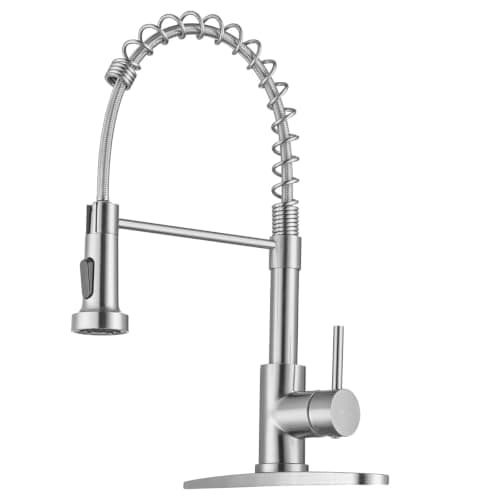
WEWE Brushed Nickel Kitchen Faucet with Pull Down Sprayer and Deck Plate (1 or 3 Hole)

The cheapest pick here, and the one that ships with the deck plate - so it drops into a one-hole or a three-hole sink without a second order.

a rental, a utility sink, or the lowest honest cost
3
An assortment of home goods and kitchenware
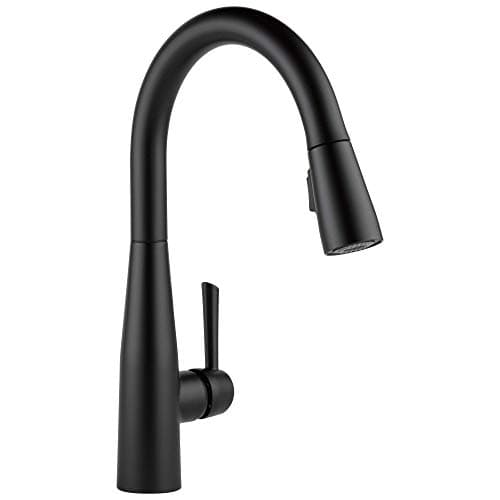
Delta Essa Matte Black Single Hole Pull-Down Kitchen Faucet, 9113-BL-DST

The black faucet I would actually buy: a slim modern pull-down from a major manufacturer, rather than an anonymous black fixture that cannot be repaired.

matte black that will still be serviceable in ten years
4
A renovation workshop with tools and a workbench
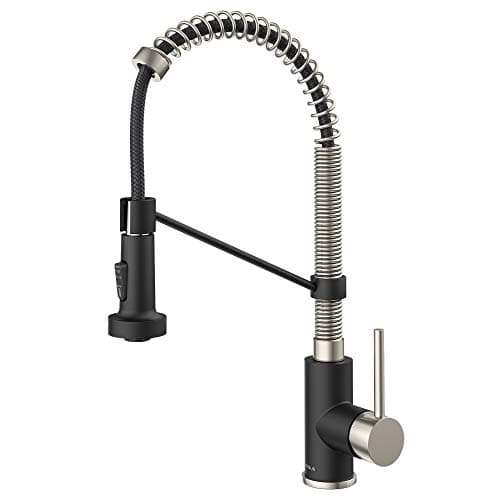
KRAUS Bolden Commercial Style Single Handle Pull-Down Kitchen Faucet, KPF-1610SSMB

The exposed spring-coil restaurant faucet, in a two-tone stainless and matte black that lets it sit next to either metal in the room.

the pro-kitchen look on a normal budget
5
An interior in earthy terracotta and sage tones
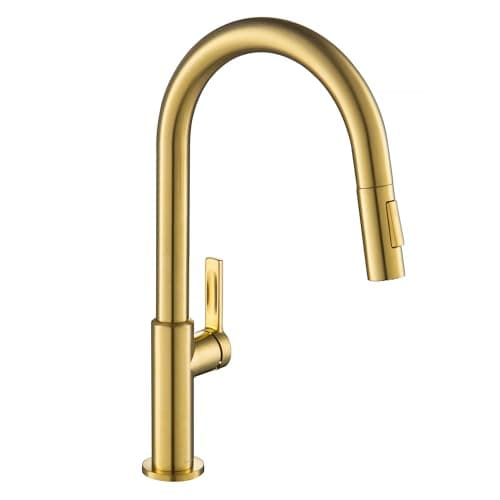
KRAUS Spot Free Brushed Brass Pull-Down Kitchen Faucet, KPF-2820BB

Brushed brass at a mid-market price, for the kitchens where warm metal is the whole point and chrome would kill the room.

a warm metal kitchen without a designer invoice
6
An interior design mood board with swatches and samples
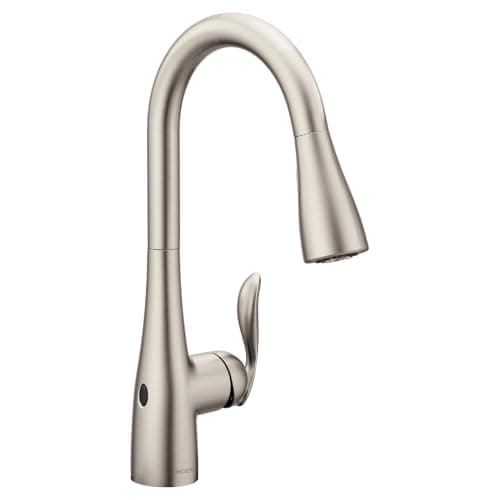
Moen Arbor MotionSense Wave Touchless Single-Hole Kitchen Faucet, 7594EWSRS

A genuinely touchless faucet - it starts on a wave of the hand, not a tap of the wrist - which is the version worth paying for if you cook with your hands full.

raw chicken, muddy hands, and anyone who cooks a lot
7
A dining table and chairs in a warm interior
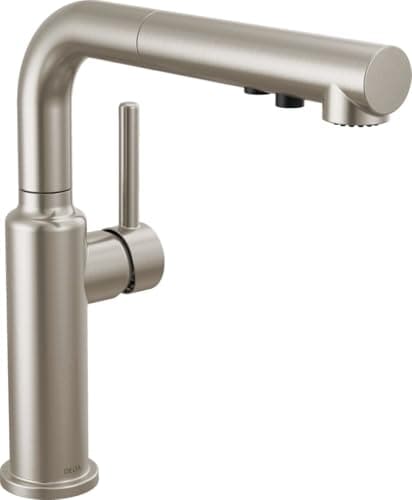
Delta Daneri Brushed Nickel Single Hole Pull-Out Kitchen Faucet, 16879-SS-DST

A lower, pull-out design rather than a tall pull-down - the shape that fits when there is a window sill, a shelf, or an upper cabinet in the way.

a sink under a window, or a shallow basin
8
A modern farmhouse interior in cozy neutrals
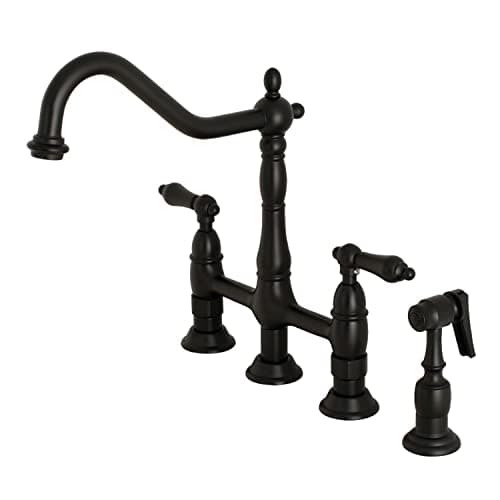
Kingston Brass Heritage Two-Handle Bridge Kitchen Faucet, 8-9/16 in, Matte Black, KS1270ALBS

The two-handle bridge faucet, with its exposed connecting tube and side sprayer - the shape that makes a farmhouse or period kitchen look considered rather than costumed.

farmhouse, period, and apron-front kitchens

Tap any row to jump to the full write-up. Prices open on Amazon in a new tab.

How we chose these picks

Every pick here is chosen the way I’d choose it for a client’s home: real-world durability first, build quality and materials second, and value for the money third. Where I’ve installed or lived with a product on a job, I say so and tell you what I saw. Where a pick is based on research and verified buyer feedback rather than hands-on use, I say that too — I never claim to have tested something I haven’t.

Read our full editorial policy for how we evaluate and update these guides.

1

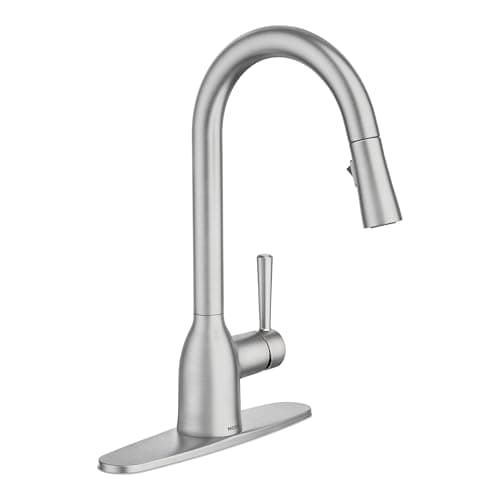
Moen Adler Spot Resist Stainless One-Handle High Arc Pulldown Kitchen Faucet, 87233SRS

Moen · Best for the everyday kitchen you want to stop thinking about
A warm kitchen with wood counters and decor

A high-arc single-handle pull-down from a brand whose replacement parts sit on the shelf at every hardware store - which is the quality that actually matters ten years in.

If you asked me to specify one faucet for a kitchen without seeing the kitchen, it would be something very close to this: a single-handle high-arc pull-down from a brand that has been selling the same platform long enough that the parts are commodity items. That last part is the whole argument. Faucets rarely die - they drip, and a drip is a cartridge, and a cartridge for a mainstream faucet is a ten-minute fix with a part you can buy locally. A cheaper faucet from a brand that has vanished by then is not repairable at any price, so it becomes a whole new faucet plus an afternoon under the sink.

$161.70 · View on Amazon

#ad · disclosure · Price as of September 19, 2026

Pros

  • Mainstream brand, so cartridges and spray heads are easy to source later
  • Spot Resist finish is designed to play down water spots and fingerprints
  • High-arc spout leaves room to wash a stockpot or a sheet pan

Cons

  • Single-hole design - on a three-hole sink you need the deck plate, so confirm one is included
  • A tall arc in a shallow sink splashes, which is a sink problem the faucet cannot fix
  • Spot Resist is a surface treatment, not a property of the metal underneath
2

WEWE Brushed Nickel Kitchen Faucet with Pull Down Sprayer and Deck Plate (1 or 3 Hole)

WEWE · Best for a rental, a utility sink, or the lowest honest cost

An affordable, cozy living room styled on a budget

The cheapest pick here, and the one that ships with the deck plate - so it drops into a one-hole or a three-hole sink without a second order.

There is an honest case for the cheapest faucet in the room, and it is not the case people usually make for it. It is not that it performs like the expensive one - it is that some sinks do not deserve an expensive faucet. A laundry-room basin, a garage sink, a basement kitchenette, a rental you are turning over between tenants: in all of those the job is a clean-looking fixture that works, and the money is better spent somewhere a guest will actually see. The included deck plate is what makes this the practical budget answer rather than a false economy, because a separate escutcheon can cost a meaningful fraction of the faucet itself.

$39.9925% off

$29.99 · View on Amazon

#ad · disclosure · Price as of September 19, 2026

Pros

  • Includes the deck plate, so it covers a three-hole sink out of the box
  • By far the lowest cost on this page, at a fraction of the branded options
  • Brushed nickel is the most forgiving finish for hard water and fingerprints

Cons

  • No established parts channel - when the cartridge goes, you are usually buying a whole faucet
  • The listing spans kitchen, laundry and RV use, so check the spout height and reach against your sink
  • Supply hoses on budget faucets are the first thing I replace, not the last
3

Delta Essa Matte Black Single Hole Pull-Down Kitchen Faucet, 9113-BL-DST

Delta · Best for matte black that will still be serviceable in ten years

An assortment of home goods and kitchenware

The black faucet I would actually buy: a slim modern pull-down from a major manufacturer, rather than an anonymous black fixture that cannot be repaired.

Matte black stopped being a trend several years ago and settled in as a standard neutral, which changes the calculation: it is worth buying properly rather than cheaply, because you will not be replacing it when the fashion turns. What you get from a major manufacturer here is not a better shape, it is a supported one - the same repairability argument as the pick at the top of this page, applied to the finish most people actually want. Buying black from a brand with no service parts is the version of this purchase I would talk a client out of.

$222.49 · View on Amazon

#ad · disclosure · Price as of September 19, 2026

Pros

  • Matte black works with white, wood, green and gray cabinets equally well
  • Major-brand platform, so replacement cartridges and spray heads stay available
  • Slim single-hole profile suits modern and transitional kitchens

Cons

  • Matte black is the worst finish for hard water - limescale dries white and shows
  • Black tones vary between manufacturers, so it may not match a black sink or black hardware exactly
  • Single-hole, so a three-hole sink needs a deck plate - confirm whether one is included before ordering
4

KRAUS Bolden Commercial Style Single Handle Pull-Down Kitchen Faucet, KPF-1610SSMB

KRAUS · Best for the pro-kitchen look on a normal budget

A renovation workshop with tools and a workbench

The exposed spring-coil restaurant faucet, in a two-tone stainless and matte black that lets it sit next to either metal in the room.

The spring-coil shape earns its keep for one physical reason: the spray head hangs from a flexible coil instead of retracting into the spout, so it moves further, in more directions, with less resistance than a hose on a counterweight. Over a deep single-bowl sink that is a genuine daily improvement, not a styling choice. This Kraus is the pick because the two-tone stainless and matte black solves the problem the style usually creates - a chrome-bright commercial faucet is loud in a domestic kitchen, and the black softens it enough to live with.

$214.957% off

$199.99 · View on Amazon

#ad · disclosure · Price as of September 19, 2026

Pros

  • The spring coil gives the spray head a huge range of movement over a big sink
  • Two-function sprayer covers the everyday rinse and the stuck-on pan
  • Two-tone stainless and black bridges a kitchen that has both metals in it

Cons

  • Commercial faucets are tall - measure to the window or upper cabinet first
  • The exposed coil collects kitchen grease and dust and needs wiping
  • The look is emphatically modern and fights a traditional or period kitchen
5

KRAUS Spot Free Brushed Brass Pull-Down Kitchen Faucet, KPF-2820BB

KRAUS · Best for a warm metal kitchen without a designer invoice

An interior in earthy terracotta and sage tones

Brushed brass at a mid-market price, for the kitchens where warm metal is the whole point and chrome would kill the room.

Warm metals were a premium upgrade for years, and the useful development is not that brass became fashionable - it is that it became affordable enough to specify in an ordinary kitchen. That matters because brass is the finish that does the most work: in a room of white cabinets and pale counters, one warm fixture stops the whole scheme from reading cold and clinical. Brushed rather than polished is the version I would put in a working kitchen every time, because polished brass turns into a fingerprint record above a dishwasher and brushed simply does not.

$299.95 · View on Amazon

#ad · disclosure · Price as of September 19, 2026

Pros

  • Brushed brass warms up white, cream, sage and wood-toned cabinets
  • The brushed texture scatters light, so it hides marks far better than polished brass
  • Costs a fraction of what warm-metal faucets used to at the designer end

Cons

  • Brass tones differ between manufacturers - it will not necessarily match your brass cabinet pulls
  • A faucet is a much bigger commitment to a metal than a handle you can swap in an hour
  • Warm metals date faster than stainless if you follow trends closely
6

Moen Arbor MotionSense Wave Touchless Single-Hole Kitchen Faucet, 7594EWSRS

Moen · Best for raw chicken, muddy hands, and anyone who cooks a lot

An interior design mood board with swatches and samples

A genuinely touchless faucet - it starts on a wave of the hand, not a tap of the wrist - which is the version worth paying for if you cook with your hands full.

Touchless is the one faucet feature I have watched change how people actually work in a kitchen, and the reason is hygiene rather than novelty. The moment it justifies itself is handling raw meat: you can start water without touching anything, wash properly, and then turn it off - instead of contaminating a handle you now have to clean. It is worth being precise about the category, though. Touch faucets start when you tap them anywhere on the spout, which still means contact; this Moen is a wave-sensor faucet, which means no contact at all. If you are paying for the feature, that distinction is the feature.

$396.776% off

$374.77 · View on Amazon

#ad · disclosure · Price as of September 19, 2026

Pros

  • Wave sensor means you never touch the handle with contaminated hands
  • Still has a normal handle, so it works the ordinary way when you want it to
  • The obvious answer for accessibility and for anyone cooking with children underfoot

Cons

  • Comfortably the most expensive faucet on this page
  • Sensor faucets need a power source - check whether it is batteries or an adapter and that there is room under your sink
  • Any sensor can be triggered by a passing sleeve or a dish rack in the wrong place
7

Delta Daneri Brushed Nickel Single Hole Pull-Out Kitchen Faucet, 16879-SS-DST

Delta · Best for a sink under a window, or a shallow basin

A dining table and chairs in a warm interior

A lower, pull-out design rather than a tall pull-down - the shape that fits when there is a window sill, a shelf, or an upper cabinet in the way.

Pull-out faucets have been quietly out of fashion for a decade while pull-downs took over, and that is a shame, because they are the right answer to a very common kitchen. If your sink sits under a window - which is where sinks have been put for a hundred years - a high-arc faucet either blocks the view or stops the window opening. This Delta is the low-profile pick because it is a mainstream, supported platform in the most forgiving finish, rather than a compromise you have to hunt for. Buying the shape that fits your kitchen beats buying the shape that is fashionable.

$244.9035% off

$158.00 · View on Amazon

#ad · disclosure · Price as of September 19, 2026

Pros

  • Low profile clears window sills and low upper cabinets that defeat a high arc
  • A pull-out wand extends horizontally, which suits filling pots on the counter
  • Less splash-back in a shallow sink than a tall arc produces

Cons

  • Shorter reach across a wide double-bowl sink than a high-arc pull-down
  • Low clearance makes filling a tall stockpot in the sink awkward
  • Single-hole, so a three-hole sink needs a deck plate - confirm before ordering
8

Kingston Brass Heritage Two-Handle Bridge Kitchen Faucet, 8-9/16 in, Matte Black, KS1270ALBS

Kingston Brass · Best for farmhouse, period, and apron-front kitchens

A modern farmhouse interior in cozy neutrals

The two-handle bridge faucet, with its exposed connecting tube and side sprayer - the shape that makes a farmhouse or period kitchen look considered rather than costumed.

A bridge faucet is doing something no single-handle faucet can: it is period-correct furniture for a kitchen, and it is the detail that makes a farmhouse scheme look like a decision rather than a mood board. The Kingston Brass Heritage line is the sensible way in because it is a specialist in traditional plumbing shapes at a mid-market price, and the matte black version keeps the whole thing from tipping into costume. Choose it for the look with clear eyes - a bridge is less convenient than a single lever, and it is worth it only if the look is the point.

$419.22 · View on Amazon

#ad · disclosure · Price as of September 19, 2026

Pros

  • The classic form for an apron-front sink, a period house, or a farmhouse scheme
  • Separate hot and cold handles let you set a temperature and leave it
  • Matte black keeps the traditional shape from tipping into pastiche

Cons

  • Bridge faucets need two holes at the right spacing - this one is listed at 8-9/16 in, so measure yours first
  • Two handles means two cartridges to service instead of one
  • The exposed bridge tube is another surface that collects kitchen dust

How to buy a kitchen faucet that actually fits

Work through these in order, before you get attached to a finish. Every one of them is a five-minute check that prevents a return, and this is the same list I run before ordering for a client:

  • Count your holes, then measure between them. Kitchen sinks come in one-, two-, three- and four-hole configurations, and the spacing between the outer holes is commonly 6 in, 8 in, or the 6-to-16 in spread used with a separate sprayer. A single-hole faucet on a three-hole sink is fixed with an escutcheon, also called a deck plate, which covers the extra openings (sink configuration guide). If a faucet does not list a deck plate as included, budget for one.
  • Measure up, not just across. From the sink deck to the underside of the upper cabinet, the window sill, or the shelf above it. This single number decides whether a high-arc pull-down is possible in your kitchen at all, and it is the measurement people skip.
  • Check the reach against your sink. The spout should deliver water near the center of the bowl - or of each bowl, on a double sink. Too short and you wash dishes against the back wall of the basin; too long and the stream lands past the drain and splashes.
  • Know the flow rate you are allowed. Since 1998 the federal standard has capped faucets at 2.2 gallons per minute at 60 psi, and it is worth knowing that the EPA WaterSense program does not currently label kitchen faucets at all - so a missing WaterSense mark on a kitchen faucet is normal, not a red flag (Building America Solution Center). Some states set a lower ceiling than the federal one, so check the rating on the box if you live somewhere with its own water rules.
  • Confirm it is certified lead free. Under the Safe Drinking Water Act, “lead free” means a weighted average of no more than 0.25% lead across the wetted surfaces of a plumbing fitting or fixture - a limit Congress lowered from 8% in 2011 (EPA lead free requirements). Every mainstream faucet sold for drinking water in the US is certified to this; it is worth verifying on a listing that does not mention it.
  • Buy a brand whose parts you can still get. Faucets almost never fail outright - they drip, and a drip is usually a cartridge. A cartridge for a mainstream faucet is a cheap part and a short job. A cartridge for a brand that no longer exists is a whole new faucet.

Do those six and the shopping part becomes easy, because you will be choosing between faucets that all physically fit. If the cabinets below are getting attention in the same project, plan the metals together rather than separately - see the cabinet hardware guide for how the finishes should relate.

Pull-down, pull-out, or bridge - matching the shape to the sink

These three shapes are not better and worse versions of each other. They suit different sinks, and picking by kitchen rather than by fashion is how you end up with a faucet that stops annoying you:

  • Pull-down. A tall arc with a spray head that pulls straight down into the bowl. The best all-rounder for a deep single-bowl sink and for anyone who washes big pans, and the shape almost every current faucet uses. Needs vertical clearance above the sink to work.
  • Pull-out. A lower spout with a wand that pulls toward you. The right answer under a window, under a low upper cabinet, or over a shallow basin where a tall arc would splash. Slightly less handy across a wide double sink.
  • Commercial or spring-coil. A pull-down with the hose carried on an exposed spring instead of inside the spout, so the head moves further and more freely. Excellent over a big sink; tall, modern, and one more thing to wipe.
  • Bridge. Two handles joined by an exposed tube, usually with a side sprayer. A period and farmhouse shape that needs two holes at a specific spacing. Chosen for the look, at some cost in convenience.
  • Bar and prep faucets. Scaled-down versions of the above for an island prep sink or a wet bar. Same rules apply - just do not put one on the main sink, where the reach will frustrate you.

If you are furnishing a kitchen from scratch rather than replacing one fixture, the shape question is worth settling alongside the sink and the counter, not after them. The wider kitchen decor guide covers how the hard finishes and the soft layers should be sequenced.

Touchless and touch faucets: what they are good at

Electronic faucets are the one place where the marketing and the real benefit have drifted apart, so it is worth separating the two categories before you spend the money:

  • Touchless means a sensor. You wave a hand and the water starts without contact. This is the version that solves the hygiene problem - raw meat, dough, paint, garden soil - because nothing you touch gets contaminated.
  • Touch means you still touch it. Tapping anywhere on the spout or handle turns the water on, which is convenient with a wrist or an elbow but does not solve the contamination problem the way a sensor does. Both are useful; they are not the same feature.
  • Both need power. Batteries or a plug-in adapter, plus a control box that has to live under the sink. Check for a spare outlet and for physical room in a cabinet that already holds a disposal, a bin and cleaning supplies.
  • Both keep a manual handle. A well-designed electronic faucet still works as an ordinary faucet, which is what you fall back on when the batteries die - and they die at the least convenient moment.
  • False triggers are the real complaint. A sensor cannot tell a hand from a sleeve or a dish rack. Think about what sits beside and above the sink before you decide where the sensor points.

My honest read after installing plenty of them: touchless earns its price in a household that cooks seriously or has small children, and is a pleasant luxury everywhere else. If the budget is tight, a good mechanical faucet plus money spent elsewhere in the room beats a cheap sensor faucet - the same logic behind decorating on a budget.

Fitting it yourself, and when to call a plumber

Replacing a like-for-like kitchen faucet is a genuine DIY job for most people - awkward rather than difficult, because the work happens on your back in a cupboard. The order below is what keeps it to an afternoon:

  • Photograph everything under the sink first. Shutoff valves, supply lines, the mounting hardware, and the sprayer hose route. You will want that picture twice, and you cannot take it once the old faucet is out.
  • Attach what you can on the counter. Thread the supply lines onto the new faucet before it goes through the deck. You have room and light up there and neither of those exists underneath.
  • Test the shutoff valves before you commit. Turn them off and open the old faucet. If a valve will not close, weeps, or the handle spins, stop and deal with that first - a seized shutoff is the single most common reason this job turns into a plumber’s job.
  • Flush the lines before fitting the aerator. Leave the aerator off, run both hot and cold for a while, then thread it on. Sediment shaken loose during the swap clogs a new aerator immediately, and the symptom - weak flow on a brand new faucet - sends people back to the store for no reason.
  • Check the sprayer hose has a clear drop. The hose and its counterweight need to hang freely. A garbage disposal, a bin, or a stack of cleaning bottles will catch it, and a spray head that will not retract properly is the most common complaint about a new pull-down.

Call a plumber when the shutoff valves are seized or leaking, when the supply pipes are galvanized or corroded, or when a faucet needs a hole drilled in a stone counter - that last one is a fabricator’s job, not a DIY one. Everything short of that is in reach of a basin wrench and some patience, which is the same spirit as the rest of my DIY home decor guide.

Frequently asked questions

How do I know how many holes my kitchen sink has?

Look at the sink deck behind the faucet and count the openings - kitchen sinks come in one-, two-, three- and four-hole configurations, and the spacing between the outer holes is commonly 6 inches, 8 inches, or the 6-to-16 inch spread used with a separate sprayer. If your sink has three holes and you want a single-hole faucet, you need an escutcheon or deck plate to cover the extras. Many single-hole faucets include one, but not all do, so check the listing before ordering.

What flow rate should a kitchen faucet have?

The federal standard has capped faucets at 2.2 gallons per minute at 60 psi since 1998, so any faucet legally sold in the US is at or below that. Some states set a lower ceiling of their own, so if you live somewhere with its own water-efficiency rules, check the rating printed on the box. It is also worth knowing that the EPA WaterSense program does not currently label kitchen faucets, so the absence of a WaterSense mark on a kitchen faucet is normal rather than a warning sign.

Pull-down or pull-out - which is better?

Neither is better; they suit different sinks. A pull-down has a tall arc and a spray head that drops into the bowl, which is ideal for a deep single-bowl sink and for washing large pans. A pull-out is lower, with a wand that comes toward you, and it is the right choice when a window sill, a shelf, or a low upper cabinet limits the height above the sink, or when a shallow basin would make a tall arc splash. Measure from the sink deck to whatever is above it, and let that number decide.

Which kitchen faucet finish is easiest to live with?

Brushed nickel and spot-resist stainless are the most forgiving day to day, because the brushed texture scatters light and plays down both water spots and fingerprints. Matte black is the most versatile with cabinet colors but the least forgiving with hard water, since limescale dries white and shows clearly on a dark surface. Brushed brass sits in between - warm, and much easier to live with than polished brass, though brass tones vary between manufacturers so it may not match brass cabinet hardware exactly.

Are cheap kitchen faucets worth buying?

For a laundry sink, a garage or basement sink, or a rental turnover, yes - the job is a clean-looking fixture that works, and the money is better spent where guests will see it. For a main kitchen faucet you use dozens of times a day, the argument for a mainstream brand is not performance, it is repairability: faucets rarely fail outright, they drip, and a drip is usually a cartridge. Cartridges for major brands are cheap and easy to find, while a faucet from a brand that has disappeared cannot be repaired at any price.

Can I replace a kitchen faucet myself?

Usually yes, if it is a like-for-like swap. The job is awkward rather than technical - most of it happens on your back inside a cupboard. Photograph everything under the sink before you start, attach the supply lines to the new faucet on the counter where you have room, and test the shutoff valves before you commit, because a seized or weeping shutoff is the most common reason this turns into a plumber’s job. Call a professional if the valves will not close, if the supply pipes are corroded, or if a new hole has to be drilled in a stone counter.

Is a touchless kitchen faucet worth the extra money?

It earns its price in a household that cooks seriously or has small children, because it solves a real hygiene problem: you can start water without touching anything after handling raw meat, dough, or garden soil. Be precise about the category, though - a touch faucet still requires contact and simply lets you tap it with a wrist or elbow, while a touchless faucet uses a sensor and needs no contact at all. Both need power and a control box under the sink, so check you have an outlet and physical room before ordering.

Ready to make your space feel like home?

Browse the roundups I'd actually hand a client — honest picks, real trade-offs, and the one to buy first.