Compare
Home Goods vs At Home: Which Is Better?
One store is a treasure hunt, the other a superstore, and here's which fits your project.
By Catherine Vizcaino · Home-renovation pro & founder
Updated September 2026
As an Amazon Associate, I Heart My Home earns from qualifying purchases. It never changes your price or our picks. Learn more.
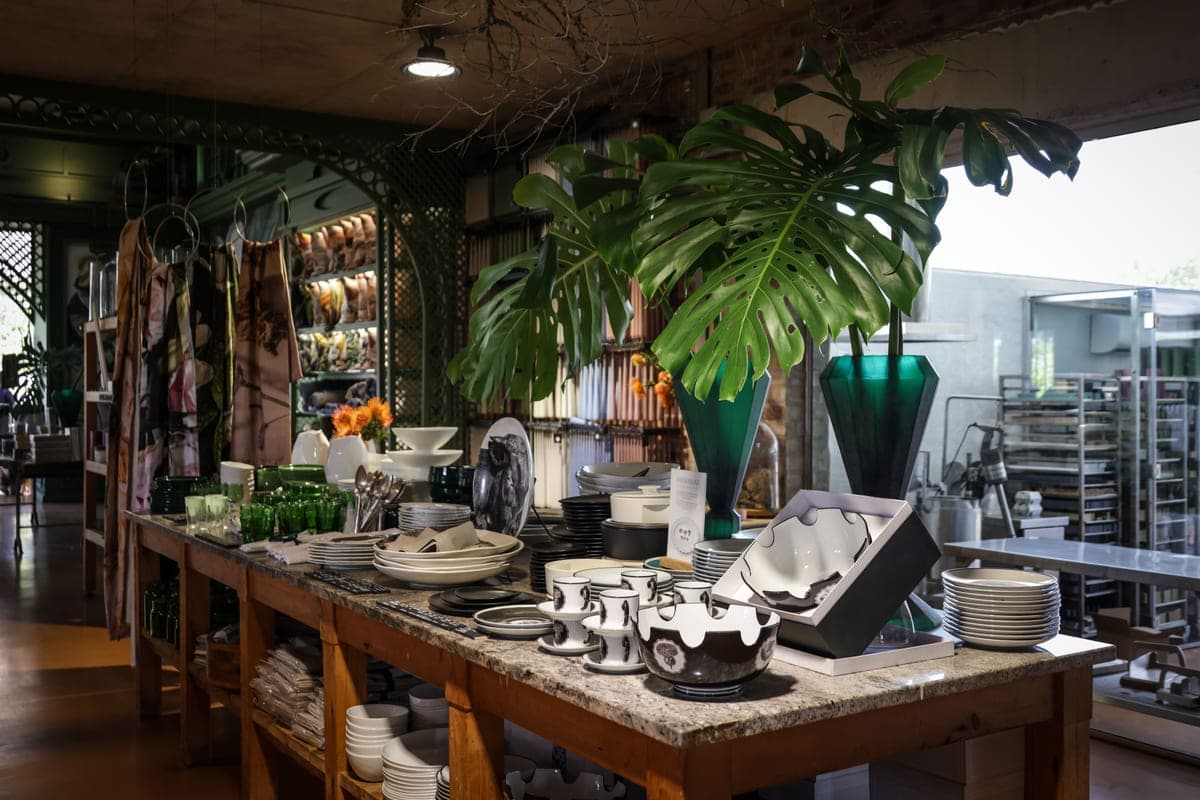
HomeGoods and At Home solve the same problem in opposite ways. HomeGoods is an off-price treasure hunt where stock changes weekly and you buy what you find. At Home is a big-box superstore with a huge, consistent range you can also shop online. Neither is simply better — it depends on how you shop.
As someone who furnishes homes for a living, I shop both, but for very different reasons. Here’s how HomeGoods and At Home compare on model, selection, price, and stock consistency, plus which one fits the job in front of you. See our roundup of the best home goods for specific picks, and our affiliate disclosure for how this site is funded.
| HomeGoods | At Home | |
|---|---|---|
| Owner | TJX Companies (NYSE: TJX) | A group of former lenders, after the 2025 Chapter 11 |
| US store count | 963 stores | 229 stores in 39 states (down from 260 in 2025) |
| Model | Off-price treasure hunt; ever-changing stock | Big-box home decor superstore; huge steady range |
| Selection & size | About 24,000 sq ft; here today, gone tomorrow | Warehouse format; a planned catalog you can re-buy |
| Price | Off-price on brand-name and designer overstock | Everyday low prices on At Home's own assortment |
| Furniture | Accent pieces and small case goods | Large furniture range, plus patio, rugs, and seasonal |
| Consistency of stock | Low by design; stock rotates constantly | High; you can usually re-buy the same item |
| Returns | 30 days with receipt; store credit after that | 60 days; 90 days for Insider Perks members |
| Online shopping | No — TJX lists no HomeGoods e-commerce site | Yes; ship to home, or free return to a store |
Bottom line: pick At Home when you need a specific look on a schedule — a full room, a color story, or seasonal decor you can shop online and re-buy later. Pick HomeGoods when you love the hunt and want brand-name pieces below full retail, and you’re flexible on exactly what you take home.
Two very different shopping models
HomeGoods is part of TJX Companies, so it runs on the off-price playbook: buy overstock and closeouts from name brands, sell them below full retail, and rotate the floor constantly. That’s what makes it fun — you never know what you’ll find — and also what makes it unpredictable.
At Home takes the opposite approach. It’s a warehouse-format home decor superstore that carries a deep, largely permanent catalog of its own assortment: furniture, rugs, wall decor, textiles, housewares, patio, and a famously large seasonal department. You’re shopping a planned range rather than whatever happened to land on the truck this week.
Selection, price, and stock consistency
The trade-off comes down to variety versus predictability. HomeGoods wins on the thrill and on brand names — you can stumble onto a designer lamp or a premium throw for a fraction of its original price. At Home wins on breadth and reliability: a single store can hold tens of thousands of items, and if you buy two matching lamps today, you can usually go back for a third next month.
- Best for one-off statement finds: HomeGoods.
- Best for outfitting a whole room to a plan: At Home.
- Best for matching sets and re-buys: At Home.
- Best for name-brand bargains: HomeGoods.
On price, neither is a luxury retailer. HomeGoods discounts higher-end brands; At Home keeps everyday prices low on its own lines. If your priority is spending as little as possible, pair this with our cheap home decor picks.
Returns and quality are worth a mention. At Home’s consistent catalog makes exchanges and returns straightforward, and you can compare items online before you commit. With HomeGoods, the trade-off for those bargains is that a piece you skip today may be gone tomorrow, so decisiveness pays. On both, I inspect anything with moving parts — drawers, legs, hinges — before it goes in the cart.
Shopping online: a real difference
This is the cleanest line between the two. HomeGoods is in-store only — there’s no full online store, so you have to show up. At Home lets you browse and buy its catalog online and pick up in store, which is a genuine advantage when you know exactly what you need or you can’t get to a location.
If online delivery is the deciding factor, you also have the whole e-commerce world to consider — compare retailers in our best home decor stores online guide, or go straight to the best home decor on Amazon.
Home Goods vs At Home prices: how each one actually gets cheap
“Which is cheaper” has no single answer here, because the two stores arrive at a low price by opposite routes. Understanding the route tells you which store will win on the specific thing you are buying.
HomeGoods gets cheap by buying wrong-season, wrong-quantity and canceled-order goods from brands that already set a high list price. The discount is measured against that original tag. So the savings are largest exactly where brands charge the most: bedding, rugs, cookware, decorative lighting, bath textiles. A $180 duvet for $50 is a genuinely good outcome and it happens routinely.
At Home gets cheap by designing to a price and selling in volume out of a warehouse-format box. There is no original high tag to discount from — the low price is the starting point. That wins where you need many of something, or a large object where shipping and floor space normally dominate the cost: big mirrors, oversized wall art, patio sets, seasonal decor by the cartful.
So, concretely, where each one tends to win on price:
- Brand-name bedding, towels and cookware: HomeGoods, usually by a lot. This is off-price at its best.
- Large mirrors, oversized art, patio, seasonal: At Home. Scale is its whole advantage.
- Anything you need four or six of: At Home. The per-unit price may be higher than a lucky HomeGoods find, but you will actually find four.
- One hero accent piece: HomeGoods, if you have the patience to go more than once.
One caution that costs people real money: neither store publishes prices you can check before you drive. HomeGoods has no online store at all, and At Home’s in-store assortment does not perfectly mirror its site. Before either trip I check a live price on a comparable item so I know what “a deal” means that week — our home decor under $50 and best home goods pages show current prices for exactly that purpose.
One thing to know about At Home before you count on it
At Home went through Chapter 11 in 2025, and it changed the store count enough to matter when you are planning a trip. The company filed in June 2025, exited in late October 2025, eliminated nearly all of its roughly $2 billion in funded debt, and took on $500 million in new exit financing. It is now owned by a group of its former lenders, including Redwood Capital Management, Farallon Capital Management and Anchorage Capital Advisors.
The practical part: At Home operated 260 locations when it filed and permanently closed about 30 of them. It now runs 229 stores in 39 states. HomeGoods, by contrast, operated 963 US stores as of January 31, 2026.
What that means for you, and nothing more dramatic than this:
- Check the store locator, don’t trust an old memory. If your nearest At Home was one of the ~30 closures, the next one may be a long drive. Eleven states have none at all.
- The odds strongly favor HomeGoods on proximity. 963 versus 229 is a four-to-one gap. For a quick errand, that is often the whole decision.
- Buy the floor model in front of you when it matters. A restructuring retailer thins assortments while it resets. If you see the thing, and it is right, take it.
To be clear: At Home came out of the process and is operating normally, and its 60-day return window is still the most generous of any store in this comparison. This is a “confirm your local store exists” note, not a warning.
Returns: At Home wins this one outright
This is the least discussed and most useful difference between the two, and it is not close.
- At Home: 60 days for unused items in original packaging, extended to 90 days for Insider Perks / Design Rewards members. Proof of purchase can be your rewards account, the credit card used, or a receipt plus valid ID. Items shipped to your home can be returned free at a local store, or mailed back through self-service in your order history.
- HomeGoods: 30 days with the register receipt for an exchange or refund. After 30 days it is store credit only. Without a receipt you get a non-transferable merchandise credit and must provide a valid government-issued photo ID, name, address and signature. Gift receipts are store credit only.
Sixty days versus thirty, plus a refund path that does not depend on finding a paper receipt, changes which store you should use for anything you are unsure about. If you are buying a rug and you are not certain about the color in your light, buy it at At Home and take it back if it is wrong. Buy at HomeGoods when you are already sure — and keep the receipt in the bag.
Which should you shop for what
- A whole room at once, to a plan: At Home. A planned catalog is the only way to buy a rug, two lamps and art that read as one collection in a single trip.
- Brand-name bedding, towels or cookware: HomeGoods. Off-price discounts bite hardest where list prices are high.
- Seasonal decor: At Home, for range and for the ability to add to the set next year.
- Patio furniture: At Home. HomeGoods does not stock patio sets as a department.
- Matching sets — four chairs, six glasses, three lamps: At Home. Off-price lots rarely give you four of anything.
- One unexpected hero piece: HomeGoods. This is what the treasure hunt is genuinely good at.
- Anything you might return: At Home, on the 60-day window alone.
- Anything you need delivered: At Home, or skip both — HomeGoods has no online store, so it cannot compete here.
- A specific item, on a specific date: neither. Buy that from a retailer with published stock.
Which is better for your project?
I reach for At Home when a client wants a cohesive, of-the-moment look and I need to buy a lot in one trip — seasonal decor, a full patio, a color-matched living room. The consistent inventory means I can plan a room instead of improvising around whatever is in stock.
I reach for HomeGoods when the budget is tight, the timeline is flexible, and one hero piece would make the space — a great mirror, an unexpected lamp, a designer pillow. It rewards patience and a good eye. Many of my best staging finds have come from a slow lap of a HomeGoods on a Tuesday morning. For the furniture side of a project, cross-check our best furniture guide before you commit.
Here’s a real example. On a recent quick-turn staging, I built the whole living area from a single At Home run — rug, two lamps, art, and a coffee table that all read as one collection — then added a single unexpected HomeGoods vase that made the room feel collected rather than catalog-bought. That split is exactly how I use them: At Home for the backbone, HomeGoods for the character.
Sources
Store counts, ownership, the restructuring timeline and both return policies below are taken from the companies’ own filings and policy pages, or from trade reporting that quotes them. Nothing on this page is estimated.
- The TJX Companies, Inc. Form 10-K, fiscal year ended January 31, 2026 — 963 US HomeGoods stores, average store size, and the merchandise categories TJX assigns to the banner.
- HomeGoods return policy — the 30-day window and the no-receipt photo-ID requirement.
- At Home return policy — the 60-day standard window and the 90-day member window.
- Retail Dive: At Home exits bankruptcy — the June 2025 filing, the late-October 2025 exit, the debt eliminated, and the 260-to-229 store count.
- At Home — current store locator and online assortment.
Frequently asked questions
Is At Home cheaper than HomeGoods?
It depends on the item. At Home keeps everyday low prices on its own assortment, while HomeGoods discounts name-brand overstock. For a specific brand-name piece, HomeGoods can beat At Home, but At Home’s pricing is more predictable across a big order.
Can you shop HomeGoods and At Home online?
At Home yes, HomeGoods no. At Home lets you browse and buy online with in-store pickup, while HomeGoods is in-store only. If online delivery matters most, see our best home decor stores online roundup.
Which has better furniture, HomeGoods or At Home?
At Home carries a much larger, more consistent furniture range, including patio sets and rugs. HomeGoods mostly stocks accent pieces and small case goods that change constantly, so it’s better for one-off finds than for outfitting a full room.
Is At Home good quality?
At Home is value-focused, so quality varies by category. Decor and seasonal items are dependable for the price; on larger furniture, inspect the construction as you would at any budget retailer. My rule on any off-price or value store: check joints, drawers, and hardware before you buy.
Which is better for seasonal decor?
At Home, for range and consistency — its seasonal departments are large and planned, so you can shop a full theme. HomeGoods gets seasonal pieces too, but the selection is smaller and unpredictable. For ideas, see our fall home decor guide.
Are At Home and HomeGoods the same company?
No. HomeGoods is owned by TJX Companies, the off-price group that also owns T.J. Maxx, Marshalls, HomeSense and Sierra. At Home is a separate company, owned since its 2025 restructuring by a group of its former lenders. They are unrelated competitors that happen to sell overlapping categories.
How many At Home stores are there?
229 stores in 39 states. At Home operated 260 locations when it filed for Chapter 11 in June 2025 and permanently closed about 30 during the restructuring, which it exited in late October 2025. HomeGoods, by comparison, operated 963 US stores as of January 31, 2026 — so check the At Home locator before planning a trip.
Which has the better return policy, At Home or HomeGoods?
At Home, clearly. At Home allows 60 days for unused items in original packaging, or 90 days for Insider Perks members, and accepts your rewards account or payment card as proof of purchase. HomeGoods allows 30 days with a register receipt, store credit only after that, and requires a valid government-issued photo ID for any no-receipt return. Buy the item you are unsure about at At Home.
Is At Home going out of business?
No. At Home filed for Chapter 11 in June 2025 and exited in late October 2025, eliminating nearly all of its roughly $2 billion in funded debt and securing $500 million in new exit financing. It closed about 30 of its 260 stores and continues to operate 229 stores in 39 states under ownership of a group of its former lenders. The only practical effect for shoppers is that your nearest location may have changed.
Keep reading
- Home Decor Stores ComparedWho owns what, store counts, and every head-to-head in one index.Read more
- HomeSense vs At HomeAt Home against the TJX banner that actually stocks furniture.Read more
- At Home vs Hobby LobbyThe two biggest seasonal destinations, and the Sunday problem.Read more
- HomeGoods vs TargetIs HomeGoods cheaper than Target? Category by category.Read more
- Kirkland's vs HomeGoodsPlus what the Bed Bath & Beyond Home conversion means locally.Read more
- Best Home GoodsOur favorite home goods, ready to order online.Read more
Ready to make your space feel like home?
Browse the roundups I'd actually hand a client — honest picks, real trade-offs, and the one to buy first.