Skip to content
IMH

Guides

How to Move a Couch With a Dolly

The answer is two dollies, not one - and five minutes of measuring before you touch anything saves an hour of wrestling.

By Catherine Vizcaino · Home-renovation pro & founder

Updated September 2026

A modern sofa in a warm neutral living room

As an Amazon Associate, I Heart My Home earns from qualifying purchases. It never changes your price or our picks. Learn more.

The single most useful thing to know before you start: a couch needs two furniture dollies, not one. One dolly under the middle of a sofa turns it into a see-saw that pivots on the spot, swinging both ends into your walls and door frames while you try to steer something that has no intention of going straight.

The second most useful thing: measure before you lift. A furniture dolly adds about 5 inches of height to the piece, and that is enough to lose you a doorway you assumed was fine. Five minutes with a tape measure prevents the classic scenario of a loaded sofa jammed in a hall with nobody able to put it down.

Below is the full sequence: what to measure, what to buy, how to get the sofa onto the dollies without a lifting injury, the doorway technique that gets a sofa through a gap narrower than it is, and what to do about stairs (the short answer: not this). I renovate homes for a living and this is the procedure I actually use. See our editorial policy for how the picks below get made.

Shop the look

Step 1: Measure four things before you touch the couch

Every genuinely bad couch-moving story starts with somebody skipping this. It takes five minutes.

  1. The couch: length, depth, and height. Depth is the one people forget, and it is the number that gets a sofa through a doorway on its side.
  2. The couch’s diagonal depth. Measure from the highest back corner diagonally down to the front of the seat base. This is the real number that decides whether a sofa fits through a door on its end, and it is almost always smaller than the height.
  3. Every doorway, hallway and turn on the route. Width and height of each. Note the narrowest point — that is your actual constraint, not the front door.
  4. The added dolly height. A standard flat dolly deck sits about 5 inches off the floor (the WEN and Simpli-Magic hardwood dollies are 5 in; the VEVOR is 5.12 in; the Mytee is 8 in thick). Add that to the couch height and check it against every doorway on the route.

That last one is the trap. An 84 inch door opening and a 34 inch tall sofa sounds like enormous clearance — until the sofa is going through on its end, at 88 inches of length, plus 5 inches of dolly. Now it does not fit, and it is already on wheels in a hallway.

Write the numbers down. Not on your phone, on the wall by the door in pencil if you have to. You will want them again when something does not fit and you need to work out which axis to rotate.

Step 2: What you actually need

The full kit for a sofa, in order of how much difference each item makes:

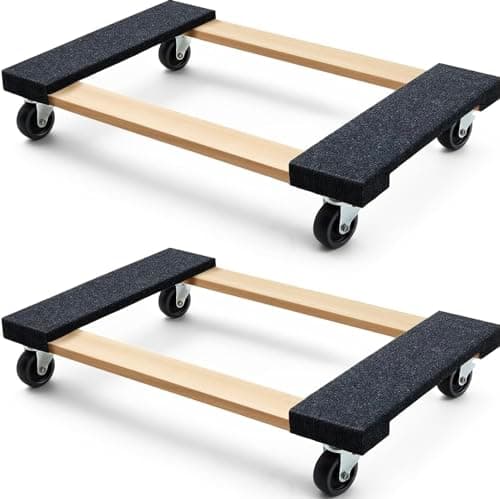
  • Two furniture dollies. Non-negotiable. Standard is an 18 x 30 in deck; hardwood pairs list a 1,320 lb dynamic load for the two together, which is far more than any residential sofa needs. The capacity is not the issue — having two is.
  • A second person. Also non-negotiable. Not for the weight, for the steering: someone has to watch the far end and the door frame while you push.
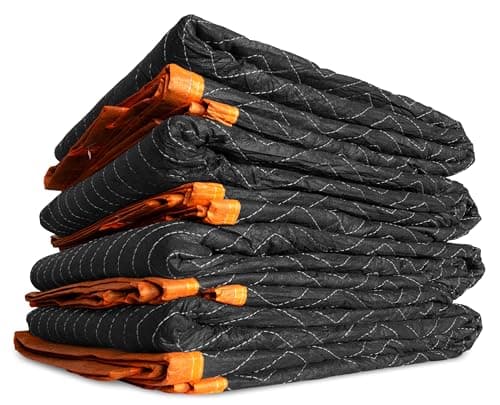
  • A moving blanket or two. Between the sofa and the dolly deck, and over the arms that will contact door frames. A four-pack of padded blankets costs less than repainting a hallway.
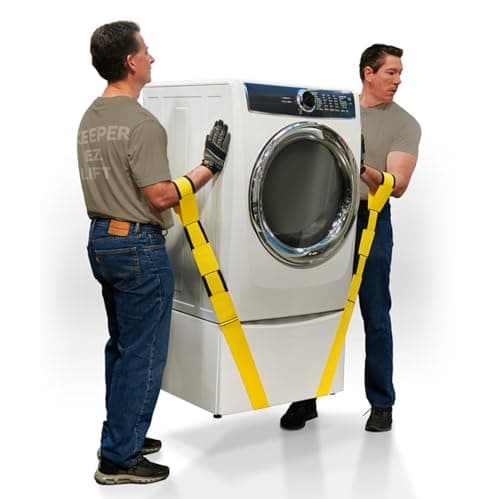
  • Lifting straps, if the sofa is heavy or you are alone-ish. A two-person set rated to 800 lb with nine length settings, or a harness set with a 12 ft x 3 in strap rated to 600 lb, moves the load to your legs and shoulders instead of your lower back. This is how you get the sofa up onto the dollies in the first place.
  • Sliders, as the fallback. If the route is all one floor and the sofa only needs to travel across a room, sliders are faster and safer than dollies and you can stop reading here. Carpet sliders are 4-3/4 in across to spread the load; hardwood sliders are 3-1/2 in felt over rubber foam.
  • A screwdriver and a bag for hardware. Feet and legs come off most sofas, and removing them is often the difference between fitting and not.

What you do not need: a hand truck. There is nothing on a sofa for a nose plate to slide under, and tipping a sofa back onto two wheels puts all the load on one arm. See furniture dolly vs hand truck for why.

Step 3: Strip and prep the couch

Ten minutes here removes most of the difficulty from everything that follows.

  1. Remove every cushion and pillow. Bag them separately. Loose cushions shift the balance and block your grip at exactly the wrong moment.
  2. Take the legs or feet off. Most screw off. This lowers the height, removes the things most likely to snap against a door frame, and gives the dolly a flat base to work with. Bag the hardware and tape the bag to the underside of the frame.
  3. If it is a recliner or sleeper, secure the mechanism. A recliner footrest that swings open mid-move is both a pinch hazard and an extra eight inches of length. Strap it closed.
  4. If it is a sectional, separate it. Sections disconnect. Each section on its own is a far easier, often one-dolly job.
  5. Wrap the arms and any exposed corners. Blanket plus stretch wrap to hold it. Arms are what hit door frames.
  6. Wipe or vacuum the dolly wheels. Grit trapped in a caster is a cutting tool you are about to drag across your floor. This is the step nobody does and the reason floors get scratched.

Step 4: Get the couch onto the dollies (without lifting it)

You do not lift a sofa onto dollies. You tip it, and the technique matters because this is the step where backs get hurt.

  1. Position both dollies first, roughly where each end of the sofa will land, with the decks parallel to the sofa and about a third of the way in from each end. Not right at the ends — a third in keeps the load over the deck when the sofa flexes.
  2. One person tips one end up just enough to clear the deck height, lifting from a squat with the back straight, or using a lifting strap under the frame. The other person slides the dolly into position with a foot — never with hands under the sofa.
  3. Lower slowly onto the deck. Check it is centred on the deck, not perched on an edge.
  4. Repeat at the other end. The first dolly will want to roll while you do this, so the first person holds the sofa steady or you chock the dolly with a shoe.
  5. Test-push it two feet before you commit to the route. If it tracks straight and nothing rocks, you are loaded correctly. If one end dips or a dolly squirms out sideways, reposition before you go anywhere.

The one thing that goes wrong here: putting the dollies too close together. The closer they are, the more the sofa behaves like it is on one dolly, which is the problem you bought two to avoid. Spread them.

Step 5: The doorway technique

Most sofas that “do not fit” through a door do fit, at the right angle. Three techniques, in the order to try them.

1. Straight through, standing up. If the door opening is wider than the sofa’s depth, stand the sofa on one end and walk it through vertically. This is where the diagonal depth measurement pays off. It is also the point where the dollies come off — a sofa on its end is carried through, not rolled.

2. The hook. For a doorway with a turn immediately behind it, lead with one arm and one back corner at an angle, then rotate the sofa around the door frame as the leading corner passes through. The sofa traces an arc rather than a straight line. This is the move professional movers make look easy, and it works because a sofa is shorter across its diagonal than along its length.

3. Take the door off. Two hinge pins and you gain 1-1/2 to 2 inches of width on each side plus the door’s thickness. When the gap is genuinely marginal, this is faster than three failed attempts and it costs nothing.

Things that help every time: blanket the door frame as well as the sofa, put one person on each side of the frame as a spotter, and never force it. If it is not going, stop, and change the angle rather than the effort. Forced sofas are how door casings crack and how upholstery tears.

Step 6: Stairs — take the dollies off

A flat furniture dolly must never go on a staircase. Not carefully, not with three people, not for one step.

The reason is mechanical. A flat dolly holds the load with nothing but friction and gravity. The moment the deck tilts, the load has somewhere to go and nothing to stop it, and it is already moving before anyone below can react. A 200 lb sofa arriving at the bottom of a staircase ahead of schedule is how people get seriously hurt.

So for a couch and a staircase:

  • Roll it to the top or bottom of the stairs on the dollies, then take the dollies off entirely.
  • Carry it, two people, one high and one low, with the low person controlling the descent and the high person controlling the weight. Lifting straps genuinely help here — they move the load to shoulders and legs.
  • Nobody stands directly below the load. The person at the bottom works from the side, off the fall line.
  • Rest on landings. Plan where you will set it down before you start, and make sure that spot exists.

For general lifting limits, the CDC’s NIOSH publishes guidance on safe manual handling, and the short version is that most people should be lifting considerably less than they assume. If a sofa and a staircase together feel like too much, that judgement is usually correct — two movers for an hour costs less than a back injury.

Protecting the floor on the way

Refinishing a hardwood floor costs many times more than every tool on this page combined, so this part is worth the five minutes.

  • Clean the wheels before the first indoor trip, and again after any trip through a garage or driveway. This is the single highest-value step and almost nobody does it.
  • Prefer non-marking wheels. Listings say so explicitly when they are — non-marring TPR, non-marking casters. Cheap hard black casters can leave scuff trails on a finished floor.
  • Vacuum a carpeted dolly deck. The carpet protects the furniture and traps the grit that scratches. Both things are true.
  • On carpet, consider sliders instead. Small casters sink into pile and steer badly. Carpet sliders are made at 4-3/4 in across specifically so the load spreads rather than sinks.
  • Lay a runner on the main route if the floor is new or freshly finished. Cardboard works.
  • Go slowly over thresholds. A 3 inch caster stops dead at a tile lip, and the load keeps going. That is the moment a sofa walks off the deck.

The kit for this job

Three items that cover the whole procedure: the pair of dollies (buy two, always), the lifting straps that get the sofa onto them without your lower back doing the work, and the padded blankets that stand between the upholstery and your door frames. Prices move, so each card shows the live current price rather than a number I typed once and let go stale.

Frequently asked questions

How do you move a couch with a dolly?

Use two dollies, not one. Measure the couch and every doorway on the route first, remove the cushions and legs, wrap the arms, then tip one end up and slide a dolly under about a third of the way in from that end — sliding it with a foot, never with hands under the sofa. Repeat at the other end, then test-push two feet before you commit to the route. Take the dollies off entirely for stairs.

Can you move a couch with one dolly?

Not well, and it is the most common mistake in this job. A single dolly under the middle of a sofa makes it pivot like a see-saw — both ends swing into your walls and door frames, and the thing has no interest in going straight. If you only own one dolly, either get a second (they are usually sold in pairs anyway) or skip the dollies and use lifting straps with two people.

How do you get a couch through a narrow doorway?

Three techniques, in the order to try them. Stand it up on one end and walk it through vertically, which works if the opening is wider than the couch’s depth. The hook — lead with one arm and one back corner at an angle, then rotate the sofa around the frame as the leading corner passes through, so it traces an arc rather than a straight line. Or take the door off its hinges, which gains you 1-1/2 to 2 inches per side plus the door’s thickness. Measure the couch’s diagonal depth first — from the top back corner down to the front of the seat base — because that is usually the number that actually fits.

Can you take a couch on a dolly down stairs?

No. A flat furniture dolly must never go on a staircase — it holds the load with friction and gravity alone, so the instant the deck tilts the load has somewhere to go and nothing to stop it, and it is already moving before anyone below can react. Roll the couch to the top or bottom of the stairs, take the dollies off entirely, then carry it with two people and lifting straps. Nobody stands directly below the load — the person at the bottom works from the side.

How much does a dolly add to the height of a couch?

About 5 inches for a standard flat furniture dolly. The common hardwood dollies measure 5 to 5.12 inches thick, and a carpeted premium model can be 8 inches. Add that to the couch height and check it against every doorway on the route before you load anything — five inches is easily enough to lose you a door you assumed was fine, and discovering it with a loaded sofa in a hallway is the worst version of this job.

Do I need a dolly to move a couch across a room?

Usually not. Furniture sliders are faster, safer and far cheaper for moving a couch within one room, and they skip the whole tip-and-load procedure. Carpet sliders are made about 4-3/4 inches across so the load spreads rather than sinking into pile; hardwood sliders are around 3-1/2 inches of felt over rubber foam. Save the dollies for moving between rooms, out of the house, or onto a truck.

Ready to make your space feel like home?

Browse the roundups I'd actually hand a client — honest picks, real trade-offs, and the one to buy first.