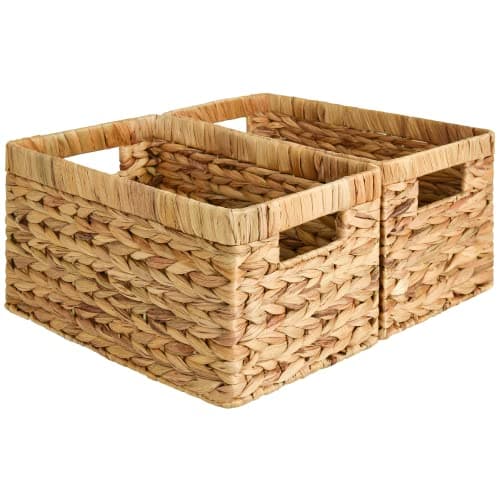
StorageWorks Woven Storage Baskets
Best for Storage that doesn't read as storage
Woven baskets that hide clutter on open shelving while looking like part of the decor.
$44.99 · View on Amazon
#ad · disclosure · Price as of September 27, 2026
Compare
Walmart has the lowest sticker prices in home. HomeGoods has the biggest markdowns. Those two sentences are both true and they point at different stores.
By Catherine Vizcaino · Home-renovation pro & founder
Updated September 2026

As an Amazon Associate, I Heart My Home earns from qualifying purchases. It never changes your price or our picks. Learn more.
This comparison turns on one distinction that most shopping advice blurs: the lowest price and the biggest discount are not the same thing, and Walmart and HomeGoods each own one of them.
Walmart’s model is low absolute prices, achieved through scale and its own house brands. If you want to spend the fewest dollars on a lamp, Walmart very likely has the cheapest lamp. HomeGoods’ model is buying brand-name overstock and closeout lots and selling them below the brand’s original list price. If you want the largest gap between what a thing normally costs and what you pay, HomeGoods wins — but the floor price is higher.
Which you want depends on whether you are optimizing for the budget or for the quality-per-dollar. Below: which store wins each category, the store counts, the return windows, and one thing about Walmart’s return policy that trips people up constantly. See the retailer hub for every store compared, and our affiliate disclosure for how this site is funded.
Best for Storage that doesn't read as storage
Woven baskets that hide clutter on open shelving while looking like part of the decor.
#ad · disclosure · Price as of September 27, 2026
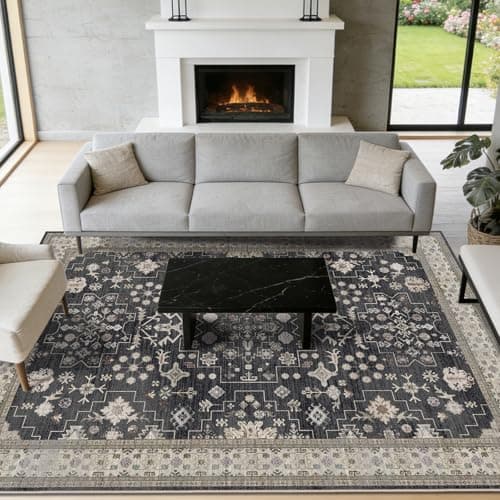
Best for A stated size, washable
A machine-washable rug in a published 5x7, so you measure first and buy second.
#ad · disclosure · Price as of September 27, 2026

Best for Quantity without the cheap look
Eight soy candles in one box — enough to place one in every room and still have spares.
#ad · disclosure · Price as of September 27, 2026
| HomeGoods | Walmart | |
|---|---|---|
| Owner | TJX Companies (NYSE: TJX) | Walmart Inc. (NYSE: WMT) |
| US store count | 963 stores | 4,611 Walmart US stores |
| Pricing model | Big discount off a brand's original list price | Low absolute prices, largely on house brands |
| Wins on | Quality per dollar in brand-name categories | The lowest number on the tag, in almost anything |
| Assortment | Unrepeatable closeout lots; a few units per item | Planned catalog plus a huge third-party Marketplace |
| Furniture | Accent pieces and small case goods | Full range, mostly online, much of it Marketplace |
| Returns | 30 days with receipt; store credit after | 90 days — but only 30 for Marketplace sellers |
| Shop online? | No — TJX lists no HomeGoods e-commerce site | Yes, with pickup and delivery from most stores |
Bottom line: if the budget is the hard constraint, go to Walmart — it will have a version of almost anything for less money, and 4,611 US stores means one is close. If you want the nicest version of a thing for a given amount of money and you are flexible on the brand, go to HomeGoods, especially for bedding, towels and cookware. One caution that matters more than the price either way: check whether a Walmart item is sold by Walmart or by a Marketplace seller, because the return window drops from 90 days to 30.
Taken literally — whose price is the smaller number — the answer is usually Walmart, and it is not close in most categories. That is what Walmart is built to do. But the literal question is rarely the useful one, so here is the more honest framing.
Walmart wins on absolute price:
HomeGoods wins on quality per dollar:
The practical way to hold both facts at once: Walmart sets the floor on what something can cost; HomeGoods raises the ceiling on what you can get for a given budget. If you have $40 for towels, Walmart gets you towels and HomeGoods might get you very good towels. If you have $12 for towels, only one of those stores is in the conversation.
This is the most useful thing on this page and it has nothing to do with price. A large share of what you see on walmart.com — especially furniture and larger decor — is not sold by Walmart. It is sold by third-party Marketplace sellers, with Walmart as the storefront. The listing looks identical.
The consequence is concrete: Walmart’s standard return policy is 90 days for most items, but items sold and shipped by a Marketplace seller may be returned within 30 days. So the return window on a $400 sofa can quietly be one third of what you assumed. Other exceptions Walmart publishes are worth knowing too: consumer electronics 30 days, prescription glasses and contacts 60 days, most wireless phones 14 days, and major appliances just 2 days.
Two days on a refrigerator is the kind of detail that costs real money if you learn it on day three. Before buying anything substantial from walmart.com, check the “sold by” line on the listing. If it is a Marketplace seller, treat it as a 30-day window and plan accordingly — and if it is a major appliance, inspect it the day it lands.
HomeGoods has no equivalent complication, because it has no online store: everything is sold by HomeGoods, in a store, under one 30-day policy.
For decor specifically — rugs, lamps, art, textiles — Walmart’s first-party 90 days is three times HomeGoods’ window, which makes it the better place to buy something you are unsure about. Just confirm it is first-party.
These cover the categories where both stores tend to disappoint for opposite reasons — Walmart’s version feels cheap, and HomeGoods may simply not have one this week. Storage that looks like decor, a washable rug in a stated size, and a candle set you can re-buy. Each card shows the live current price.
Usually not on the price tag. Walmart is built for low absolute prices and generally has a cheaper version of almost anything. HomeGoods gives a bigger discount off a brand’s original list price, so it wins on quality per dollar in brand-name categories — bedding, bath towels, cookware. The lowest price and the biggest discount are different things, and each store owns one of them.
90 days for most items sold by Walmart. But items sold and shipped by a third-party Marketplace seller may only be returnable within 30 days, and Walmart publishes shorter windows for some categories — 30 days on consumer electronics, 60 on prescription eyewear, 14 on most wireless phones, and just 2 days on major appliances. Check the “sold by” line before you buy anything substantial.
HomeGoods, in the categories where it has stock. Because it sells brand-name overstock rather than goods designed down to a price point, the materials and finish are generally better for the same money — most obviously in textiles and cookware. The trade-off is that you cannot count on finding a specific item, a matching pair, or a particular size, and there is no website to check first.
No. HomeGoods is owned by The TJX Companies, Inc. (NYSE: TJX), alongside T.J. Maxx, Marshalls, HomeSense and Sierra. Walmart Inc. (NYSE: WMT) is a separate, unrelated company. For the full ownership map of every major home store, see our retailer hub.
Walmart US operated 4,611 stores as of January 31, 2026. HomeGoods operated 963 US stores as of the same date. That roughly five-to-one gap matters more than it looks: a HomeGoods trip is a gamble you cannot check in advance, so the further the drive, the worse the odds look.
Browse the roundups I'd actually hand a client — honest picks, real trade-offs, and the one to buy first.